
Why Processor Bit Counts Are Powers of 2?
A Deep Dive into Architecture, History, and Efficiency of Processor Bits

Introduction
From the Intel 8086 to modern 64-bit processors, most CPUs have bit counts that are powers of 2 (8, 16, 32, 64). This design choice isn’t arbitrary—it’s rooted in binary logic, hardware efficiency, and historical evolution.
In this article, we’ll explore why powers of 2 dominate processor architecture, examine exceptions and demonstrate how software and hardware leverage these designs.
Table of Contents
The Binary Foundation
Historical Context: The 8-Bit Byte Revolution
Memory Alignment and Access Efficiency
Address Bus and Memory Mapping
Hardware Simplification: Counters and Registers
Exceptions to the Rule
Code Examples: Efficiency in Practice
Modern Architectures: 64-Bit and Beyond
Conclusion
1. The Binary Foundation
Computers operate in binary (base-2), where each bit is a 0 or 1. Powers of 2 align naturally with this system, simplifying operations like addressing, arithmetic, and data alignment.
Key Concepts:
Bit: The smallest unit of data (0 or 1).
Byte: 8 bits (adopted as standard in the 1960s).
Word Size: Number of bits a CPU processes at once (e.g., 32-bit, 64-bit).
Example: A 32-bit register can hold values from 0 to 232−1232−1.
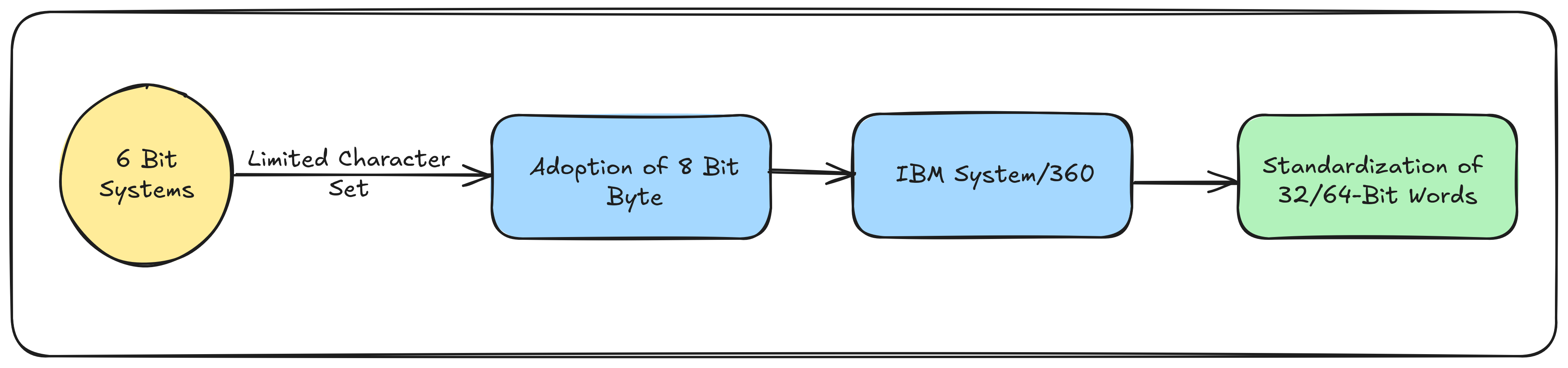
2. Historical Context: The 8-Bit Byte Revolution
The IBM System/360 (1964) popularized the 8-bit byte, balancing character encoding (ASCII) and numeric efficiency (two BCD digits per byte).
Why 8 Bits?
Character Encoding: 8 bits allowed 256 characters (vs. 64 with 6 bits).
Numeric Storage: Two Binary-Coded Decimal (BCD) digits fit in one byte.
Hardware Compatibility: Aligned with emerging memory and bus designs.
3. Memory Alignment and Access Efficiency
Processors fetch data in fixed-size blocks. Aligning data to power-of-two boundaries reduces memory access and hardware complexity.
Example: 32-bit Data Access
Aligned Address (0x0000): Single fetch.
Unaligned Address (0x0001): Requires two fetches and shifting.
Code Snippet (C):
#include <stdio.h>
#include <stdint.h>
#include <inttypes.h>

struct AlignedStruct {
    uint32_t a; // 4 bytes, aligned to 4
    uint32_t b; // 4 bytes, aligned to 8
} __attribute__((aligned(8)));

struct UnalignedStruct {
    uint32_t a;
    uint32_t b;
} __attribute__((packed));

int main() {
    printf("Aligned size: %zu\n", sizeof(struct AlignedStruct));  // Output: 8
    printf("Unaligned size: %zu\n", sizeof(struct UnalignedStruct)); // Output: 8 (but may require extra cycles)
    return 0;
}
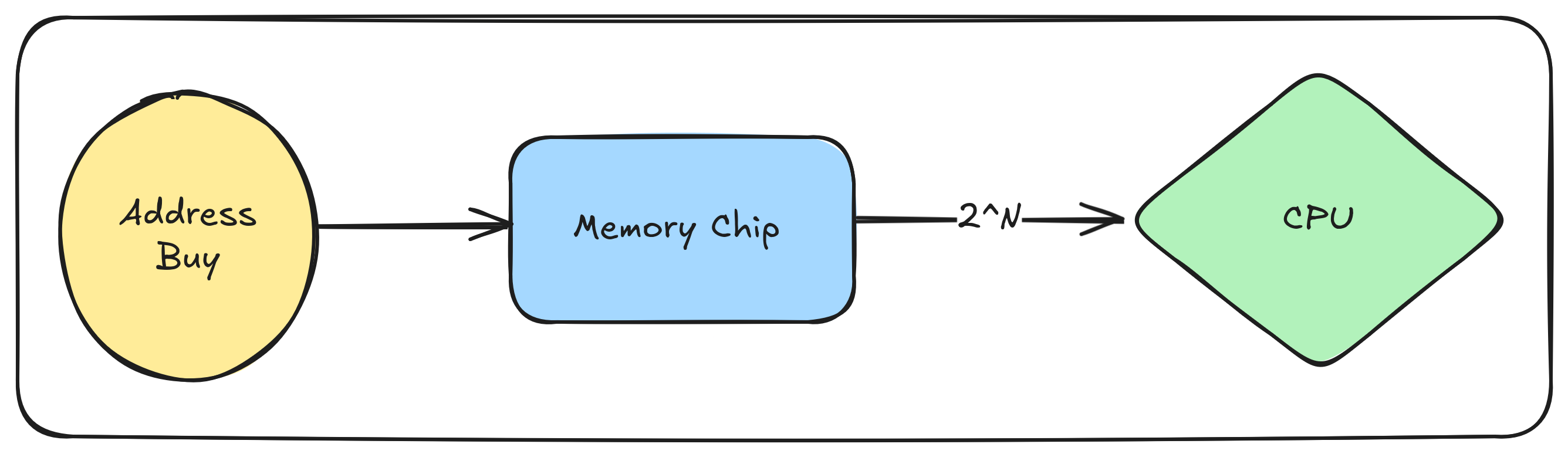
4. Address Bus and Memory Mapping
An NN-bit address bus can access 2^N locations. Powers of 2 maximize addressable space without fragmentation.
Example:
16-bit address bus → 65,536 addresses.
20-bit (Intel 8086) → 1,048,576 addresses via segmentation.
5. Hardware Simplification: Counters and Registers
Power-of-2 sizes simplify counters and logic circuits.
3-Bit Counter Example:
Counts 0–7 (8 states) for 8-bit bytes.
Non-power-of-2 (e.g., 12 bits) requires 4-bit counters with unused states.
Verilog Code:
module Counter3Bit (input clk, output reg [2:0] count);
always @(posedge clk)
    count <= count + 1; // Cycles through 0-7
endmodule
6. Exceptions to the Rule
6.1 Intel 8086 (20-bit Address Bus)
Used segmentation to access 1 MB of memory:
Segment register (16-bit) << 4 + Offset (16-bit) = 20-bit address.
6.2 24-Bit Systems (ICL 1900)
6-bit bytes, limited to uppercase text.
Phased out due to inefficiency.
7. Code Examples: Efficiency in Practice
7.1 Bitmasking vs. Division
# Power-of-2 modulus using bitmasking (fast)
def mod_power_of_two(num, divisor):
    return num & (divisor - 1)

print(mod_power_of_two(15, 8))
7.2 Hash Tables with Power-of-2 Sizes
#define TABLE_SIZE 1024 // 2^10

unsigned int hash(int key) {
    return key % TABLE_SIZE;
    // Equivalent to: key & (TABLE_SIZE - 1)
}
8. Modern Architectures: 64-Bit and Beyond
8.1 Why 64-Bit?
Addresses 264264 bytes (16 exabytes).
Future-proofing and compatibility.
8.2 RISC-V and 128-Bit Possibilities
RISC-V ISA supports 128-bit extensions.
Current implementations use 64-bit, reserving bits for future use.
9. Conclusion
Power-of-2 bit counts simplify hardware design, memory access, and software optimization. While exceptions exist, the benefits of binary alignment ensure this trend continues. As computing evolves, 64-bit architectures will dominate until new paradigms emerge.
Further Reading
IBM System/360 Technical Journal (1964).
Intel® 64 and IA-32 Architectures Software Developer Manuals.
RISC-V ISA Specification.
This exploration highlights the intersection of history, engineering, and mathematics that shapes modern computing. Whether writing low-level code or designing hardware, understanding these principles is key to building efficient systems.
Typo in 8.1: "Addresses 264264 bytes (16 exabytes)"
Another important reason for why the IBM System/360 popularized the use of power-of-two word sizes is that it made software forward compatible; software written for an 8-bit machine could be transferred over to a 16-bit one without modification. The System/360 was the first attempt at making a unified architecture in which software could run across hardware with different capabilities.
Before that, hardware was completely fragmented. Word sizes ranged from as small as 6 bits all the way to 60 bits, so even if you got past the differences in instruction sets, mathematical calculations might give completely different results due to the word size and data representation.
Software engineering has always been the most expensive part of computing, so being able to upgrade the hardware without changing the software is the reason that the power-of-two trick has been implemented in practically all new hardware designs since then.